

Ready for the Cyber Resilience Act?
Your Documentation Could Make the Difference.
Published on 08.01.2025
The Cyber Resilience Act requires you to understand risks—and your documentation to explain them.
The Cyber Resilience Act (CRA) is more than just another EU regulation. It’s a critical step toward making digital products safer and strengthening trust in an increasingly connected world. For companies, this isn’t just a challenge—it’s an opportunity to differentiate through innovative approaches and excellent documentation. One thing is certain: the right documentation can become a strategic competitive advantage.
Cyber Resilience Act: What You Should Know.
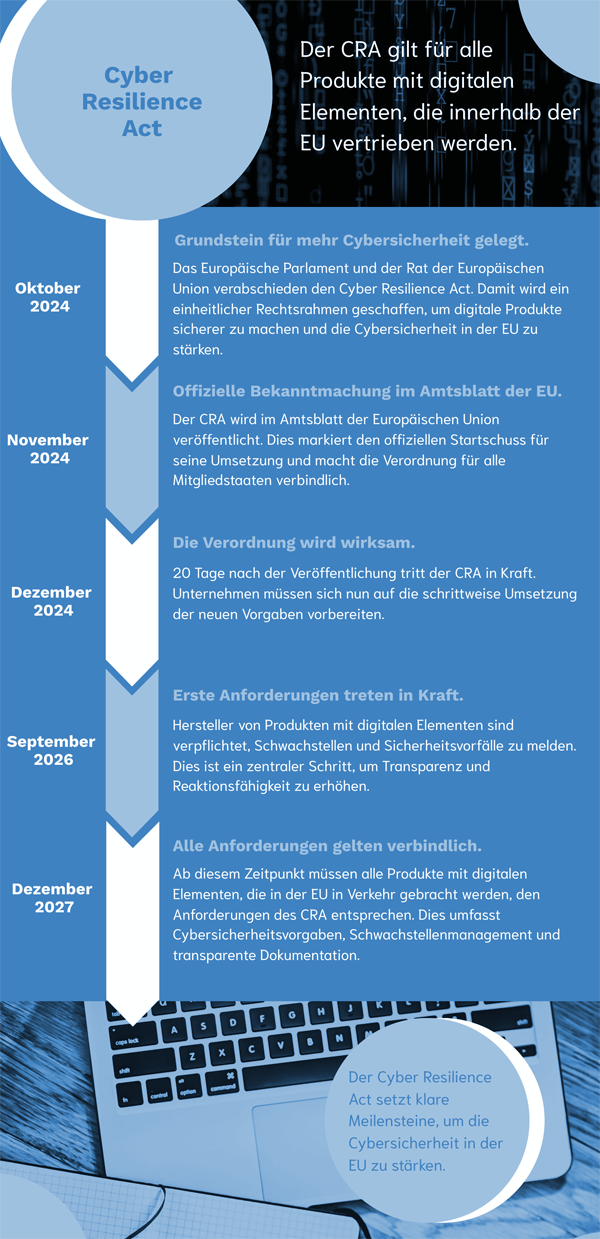 CRA Implementation Timeline - click to enlarge
The CRA applies to all products with digital elements sold within the EU—from IoT devices to network solutions to industry-specific software applications. Its goal is to enhance cybersecurity through unified standards and reduce the probability of risks like data breaches or hacking attacks, or mitigate their impact.
CRA Implementation Timeline - click to enlarge
The CRA applies to all products with digital elements sold within the EU—from IoT devices to network solutions to industry-specific software applications. Its goal is to enhance cybersecurity through unified standards and reduce the probability of risks like data breaches or hacking attacks, or mitigate their impact.
With its entry into force in December 2024, the gradual implementation of the CRA began. The regulation gives companies clear deadlines to implement new requirements and meet legal obligations. A detailed overview of key dates can be found in the infographic.
Beyond technical security requirements, the CRA highlights the importance of documentation. Companies must not only ensure compliance with legal requirements but also clearly document it. While IT and development teams are responsible for technical security measures, technical writers handle documentary requirements, implementing them with legal and content precision. From user manuals to internal processes: documentation must be comprehensive, traceable, and audience-appropriate.
From Mandatory Program to Competitive Advantage.
Well-conceived documentation is far more than a legal obligation. It builds customer trust, facilitates regulatory review, and optimizes internal processes. It can even reduce liability risks by clearly demonstrating how security requirements were met and risks minimized. But what does this look like in practice?
Consider an example: A company develops cloud-based CRM software for mid-sized businesses. Documentation begins with the product idea: data protection compliance and integration capability with existing systems are captured. During development, technical documentation describes APIs, security mechanisms like data encryption, and test protocols. After market launch, user documentation ensures administrators can efficiently configure the software and users can intuitively operate it. Each audience must be supplied with exactly the information they need—in a form that’s understandable and helpful to them.
Internal documentation is equally crucial. It provides development teams with clear information for product updates or security patches and ensures all product-related processes run smoothly. This includes:
- Conception Phase: Documentation of ideas and requirements.
- Development Phase: Description of technical details and test protocols.
- Market Launch: Creation of guidelines for updates and adjustments.
- Product Discontinuation: Support through organizing support and transition solutions.
This comprehensive approach enables all stakeholders to access relevant information at any time. Companies that use documentation strategically save time and costs—especially for product changes or new legal requirements.
Why Documentation Expertise Is Critical.
Technical writers play a central role in implementing the CRA’s documentary requirements while serving a company’s various audiences. Their work includes creating content that’s equally understandable and accessible for development teams, end users, and authorities. Their understanding of respective needs is essential.
Through close collaboration with IT, security, and development teams, technical writers ensure documentation not only meets legal requirements but is also technically precise and user-friendly. They establish standards that guarantee content consistency and quality, thus contributing to internal process optimization. Their expertise is indispensable for helping companies respond flexibly to new challenges.
How Technology Is Revolutionizing Documentation.
Modern tools help technical writers complete their tasks more efficiently and purposefully. AI-powered applications take over recurring tasks like localization or creating standardized content, creating space for strategic and creative activities. These technologies complement technical writers’ work by accelerating routine tasks while enabling audience-appropriate documentation.
Machine-readable formats offer a decisive advantage: they enable seamless integration of documentation into automated processes. For example, testing and production systems can directly access machine-readable security data to accelerate reviews and avoid errors. This reduces manual effort and increases accuracy in implementing security measures. Simultaneously, modular approaches promote flexible content adaptation to new requirements, further boosting efficiency.
How to Safely Implement the Cyber Resilience Act.
Implementing the CRA presents companies with a complex task—from meeting technical security standards to legally compliant documentation. Valuable support comes from Technical Guideline TR-03183, published by BSI. Chapter 6 in particular provides detailed instructions on how documentation can be created legally and technically correctly. This guideline serves as practical orientation for purposefully implementing CRA requirements.
To successfully implement CRA documentation requirements, companies should take targeted measures:
-
Inventory of Documentation and Security Processes: Review existing documentation for completeness and currency. Typical weaknesses can include insufficiently documented security updates, missing risk analyses, or outdated process descriptions. Systematically capture these to create a foundation for targeted improvements.
-
Create an Action Plan: Develop a clear roadmap to close identified gaps. Set priorities based on legal requirements and business objectives.
-
Cybersecurity Measures: Companies should ensure security strategies are defined and regularly updated. This includes conducting and documenting vulnerability management to effectively minimize risks.
-
Documentation According to CRA Requirements: All cybersecurity measures should be described precisely and traceably. This includes regular updates and security strategies that create transparency and facilitate regulatory review. Clear documentation also strengthens customer and partner confidence.
-
Early Integration of Technical Writers: Ensure technical writers are integrated into the process from the start. They’re crucial for creating audience-appropriate, CRA-compliant documentation.
-
Training for Involved Teams: Create awareness of documentation’s importance within the CRA framework. Train teams specifically to identify weaknesses and develop effective documentation strategies. These trainings should be based on inventory findings and tailored to each department’s specific requirements to promote smooth and efficient collaboration.
These action recommendations help companies not only meet legal requirements but also create real value for their organization and audiences.
CRA and Documentation: Securing Success and Trust.
The CRA demands more than mere compliance with legal requirements. It offers companies the opportunity to optimize internal structures and establish themselves long-term as reliable market partners. Technical writers play a key role: they ensure complex technical information is audience-appropriately prepared and documented, creating a bridge between cybersecurity measures and legal conformity.
Through professional documentation that considers both technical and organizational aspects, companies can not only meet legal requirements but also minimize liability risks and strengthen customer and partner confidence. The new Product Liability Directive complements the Cyber Resilience Act by defining clear liability requirements for software and digital products for the first time. Together, both frameworks underscore the central role of precise and transparent documentation in minimizing legal risks and ensuring safety in handling digital products. Additionally, collaboration with technical writers provides innovation impulses: processes can be designed more efficiently and new information delivery possibilities explored.
Companies that act early and consistently align their documentation strategy with CRA requirements benefit long-term from improved competitiveness and sustainable security standards. Let’s jointly use the opportunities the CRA offers—for a safe and successful future.
Further Information:
- BSI - General Information Cyber Resilience Act
- BSI - Technical Guideline TR-03183
- heise iX - Cyber Resilience Act
- heise online - Deadline for EU-wide Product Liability for Hardware and Software Begins
- EUR-Lex - Product Liability Directive
- heise magazine - Developers Drowning in Technical Debt
- OWASP Developer Guide - Implementation Documentation
- NIST - Management Guide Software Documentation