

Offload Routine, Gain Time:
How LLMs Support Technical Documentation.
Published on 10.12.2024
Is AI pulling the rug out from under technical writers? No—it’s building the foundation for their future.

Technical documentation is built on precision, structure, and clear communication. Yet as technical writers and information developers, we face growing challenges: increasing demands, more complex content, and tighter deadlines. Traditional workflows often hit their limits, especially as complexity rises and timelines shrink.
This is where technologies like Large Language Models (LLMs) come in. They automate routine tasks, structure information efficiently, and boost our productivity. But AI isn’t replacing our work—it’s a tool that creates space for what truly matters: user-centered, purposeful documentation.
I thrive in teams built on open communication and the pursuit of excellent solutions. With a commitment to continuous growth and openness to new challenges, I aim to make a tangible impact on every project.
Boosting Efficiency, Creating Space.
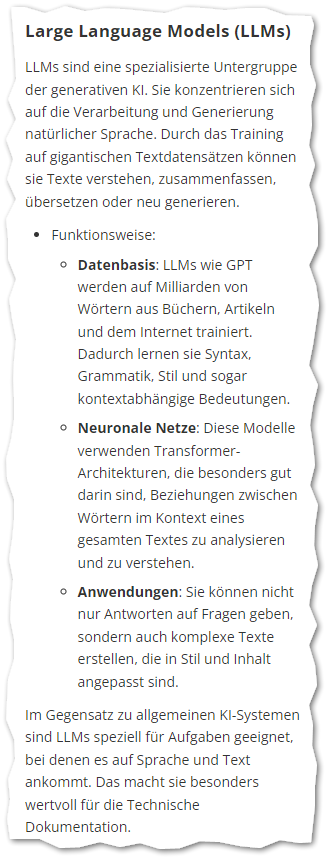
Understanding the basics of LLMs helps clarify their value in technical documentation. Generative AI, which includes LLMs, creates content like text, images, or music. It uses neural networks that analyze vast datasets and extract patterns. LLMs like GPT-4 focus exclusively on language, analyzing and generating text based on extensive training data. They master syntax, style, and context—making them a powerful tool in our work.
In practice, LLMs excel at language-based tasks: drafting instructions, FAQs, or standardized text modules faster and more consistently. They’re particularly useful for localization and translation, providing initial drafts that professionals can refine.
LLMs also simplify content structuring in formats like DITA XML or Markdown. By taking over tedious routine work, they free up time for creative and strategic tasks.
This newfound space opens exciting possibilities. We can dive deeper into audience needs, improve information architecture, or develop innovative formats like interactive guides, chatbots, or AR/VR documentation. There’s also more room for maintaining terminology databases and style guides, plus integrating user feedback. LLMs don’t just change how we work—they transform what we can focus on.
Challenges of Using AI.
Despite their benefits, LLMs come with challenges. Since they operate on probabilities rather than verified knowledge, generated content can be inaccurate or misleading. In technical documentation, where precision and reliability are paramount, thorough human review remains essential.
Data security is another concern. Cloud-based LLMs require strict adherence to data protection regulations to prevent unauthorized access. Training data quality is also critical: biased or incomplete datasets can produce flawed or prejudiced results. These factors demand careful, responsible use of the technology.
Ethical Considerations and Responsibility in AI Use.
AI deployment raises ethical questions that can’t be ignored. Transparency is key: readers must know when content has been created or assisted by AI. Biases in training data can be problematic and must be addressed through careful review to ensure neutral, respectful content.
As professionals, we’re responsible for using AI deliberately and critically. This means strictly following data protection regulations and ensuring documentation quality. Human expertise remains indispensable for guaranteeing that generated content is accurate, reliable, and user-friendly.
A Look Ahead.
LLM capabilities will continue to specialize. Industry-specific applications and innovative media formats like AR/VR or interactive documentation may gain even more importance. For us as information developers, this means taking on a strategic role where we purposefully connect technology with user needs. This evolution opens new horizons for our discipline—shaped by human-machine collaboration.
This article was created in collaboration with AI technology. The content reflects my personal perspective and experience, with AI serving as a tool for structuring and formulation. This example demonstrates how humans and machines can co-create content—a practical illustration of what's described in the article.